
01/03/2017
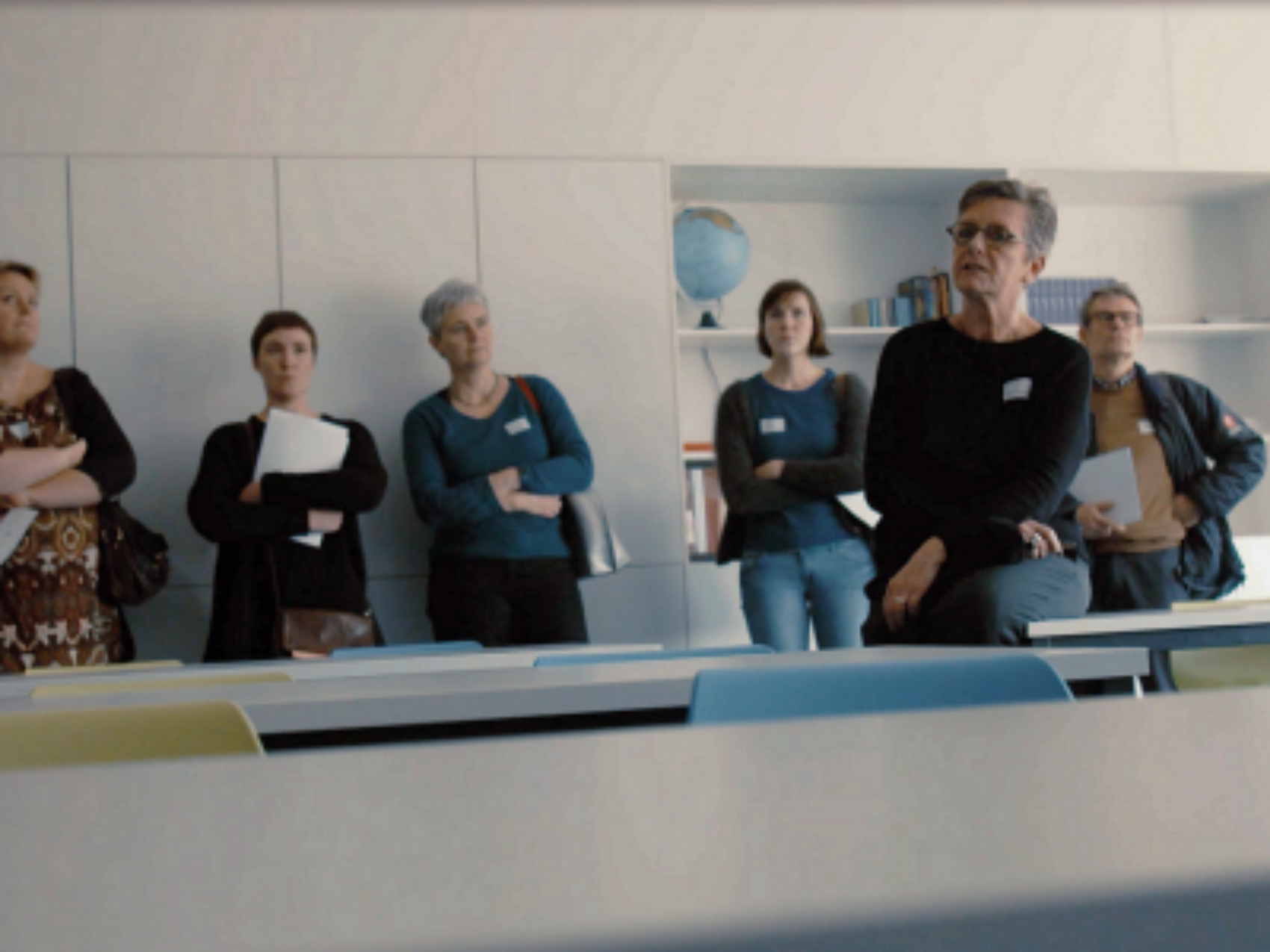
The new K-building for the Provincial Arts School in Hasselt is an artistic building with plenty of light, air and space. The building stimulates the creativity of its users whilst exuding a sense of calm. The design’s greatest strength lies in the connection between the spaces, which reinforces a sense of togetherness. Openness and transparency are key words, as are flexibility and innovation. The acoustic challenges, in particular, were no small feat.
Discover how the school and the design team have brought to life the best-equipped art school in Flanders.
Watch the report on YouTube:
To the north-east of Hasselt town centre lies the only art school in Flanders that, with the exception of ballet, offers the full range of KSO (secondary art education). Over the past decade, pupil numbers have risen and even doubled to 660 pupils. They find their niche in courses such as performing arts, visual arts, audiovisual studies and architectural arts. This secondary school prepares its students for further education in higher vocational and academic institutions. The lack of space and the need to continue offering a high-quality range of artistic subjects prompted the management to expand the school’s infrastructure.
The new building, constructed under the DBFM ‘Schools of Tomorrow’ programme, has now been in use for a year, but this was not the school’s first such project. Over time, the arts campus had grown into a jumble of old and newer buildings. In 2010, another new building was erected to accommodate five new courses of study, including Creative Writing and Drama. One of the key principles of the Schools of Tomorrow design was therefore to reconnect the various buildings on the campus, both physically and visually.
The 5,000 m² new building consists of five clusters arranged around a central, enclosed courtyard. These main areas are the dining hall, the sports hall, the theatre classrooms for the Creative Writing and Drama department, the classroom wing and the communal area leading to the library and study hall. The building comprises two storeys. A glass walkway creates a physical passageway to and from the existing buildings. The architects at Stéphane Beel architects established connections between the various departments and sections of the school. Thanks to the transparency and logical spatial layout, pupils come into contact with other courses and events. Cross-pollination, a sense of community and a broad, open outlook are the natural result of this.
Students must not be confined to a cubicle and simply shut away in their classrooms. We established connections between the various parts of the school. In this design, students can see something else happening throughout the building that may also be of interest to their course. These connections are important in every design and every school, but certainly in an art school.
Stéphane Beel – architect
Every space has its own function and characteristics. Grouping these classrooms together presented an acoustic challenge that the designers did not shy away from. In the drama classes, children must be able to sing and dance freely. In the study room, it must be calm and quiet. Yet these classrooms are situated one above the other, and this works exceptionally well. Stricter requirements have been imposed on all walls, floors and ceilings in terms of sound insulation and acoustics. For instance, the floor slab of the music room rests on a rubber mat, and in the drama classrooms, acoustic walls and ceilings have been chosen that also lend the space a certain atmosphere.
Another requirement for this design was to be able to use the new classrooms as much as possible and as simply as possible. In the Arts Sixth Form, most spaces are designed to be multifunctional and flexibly laid out. In no time at all, the sports hall can be converted into three separate sports halls; the four independent theatre classrooms can be converted into a single theatre with a retractable tier seating 120 people, with a control room situated above. The multi-purpose space serves simultaneously as an entrance area, a play and relaxation area during breaks, a venue for showcases, performances and all manner of activities, from a brunch to even a Christmas market. Even the walls have been adapted to the needs of arts education. All interior walls are white, fairly plain and fitted with hanging systems. Perfect for organising numerous showcases with ease.
We consider it very important that we can organise all our exhibitions and activities smoothly. Among other things, the theatre and the meeting room are technically very well equipped and easy to reconfigure. As a result, they are used very frequently.
Greet Nivelle – Provincial Arts Secondary School Hasselt
The new K-building offers a striking contrast between innovation and authenticity. The classrooms are equipped with modern digital boards. These are touchscreens with built-in PCs and excellent image quality. This system eliminates the need for cables and projectors; a significant improvement for the teachers. Yet ‘the book’ has also been given a new lease of life. The management is convinced that works of art, architecture and photography are better showcased on paper than on a screen. Previously, however, the library was located in a closed-off room with no windows. The new library is very open and accessible. It opens onto the meeting area and study hall and has transparent partition walls.
Under the new study rules, pupils are now allowed to borrow books during their study period. Previously, pupils spent that time in an old refectory, an unpleasant room. Now, study time is put to better use. For the past year, pupils have been studying effectively rather than just hanging around and chatting. That is a huge improvement.
Greet Nivelle – PIKOH
One year after it opened, it is clear that this art school perfectly meets the users’ expectations. The feedback has been positive, from the management, the staff and the students alike.
I am convinced that our students really enjoy being here. The architecture students in particular feel that they have a very special building here, and that it is not so common to have the same spatial experience in every school.
Greet Nivelle – PIKOH