
09/02/2017
Katholiek Onderwijs Stad Herentals, or kOsh for short, had five different secondary schools. Together, they covered the entire spectrum of aso, tso, bso and kso. So there was plenty of choice for young people in Herentals. But they did have to choose. From the first year of secondary school, they had to choose a specific school with a specific focus and specialism. Choosing whether or not to attend the same school as their friends. That is why the school board decided to take a different approach. To combine the strengths of the five campuses into a single joint lower secondary campus. And for that, a new build with Scholen van Morgen was the ideal solution.
The Ieperstraat Campus is located in the centre of Herentals and has been in full use since 9 January 2017. A 9,924 m² new-build, designed by CONIX RDBM Architects and constructed by contractor MBG. Every day, 870 pupils head there to study agricultural and biotechnical sciences, classical studies, hairdressing, mechanics and electricity, and more. They do all this on the same campus. They choose their own pathway, but get a taste of the other courses.
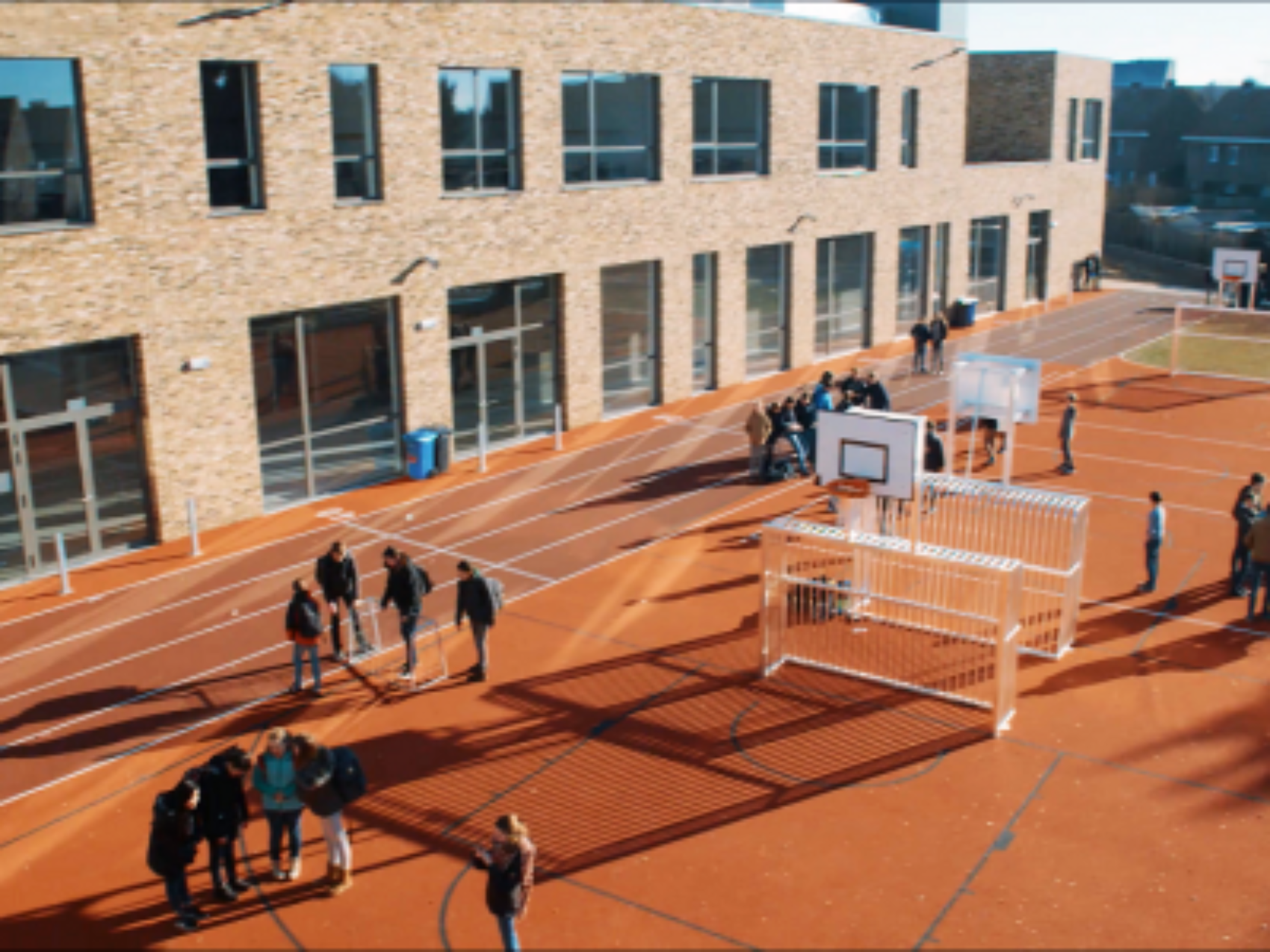
All the specialist classrooms can be seen from the playground, and inside the building too, the school and architects opted for plenty of glass. This allows pupils walking through the building to see what is happening. “To subtly stimulate interest in those subjects that the student may not yet have decided on for themselves: does this interest me right now?”, explains Marc Peeters, financial and logistics director at kOsh.
“Everyone can actually look in from anywhere.”
Marc Peeters – kOsh
And yet, at the same time, the campus offers a great sense of security. The playground feels like a small and cosy village square where everyone knows everyone else, regardless of what they’re doing. This is partly due to the layout of the playgrounds.
The bridges connecting the two building volumes create covered play areas on the one hand and extra space on the upper floor on the other. This means there is both a cosy seating area under the stairs and an additional play area on the roof, complete with table tennis tables.
In addition, a great deal of attention was paid to the sports facilities. “Instead of simply creating a boring little basketball court, we designed it with a more playful aesthetic, by allowing the running track and the basketball court to merge into one another,” explains Nathalie Van de Walle of CONIX RDBM Architects.
“The campus acts as a boundary to the rather featureless outdoor space surrounding it, effectively creating an entirely new living environment tailored to the pupils. This is reflected in the very fresh colour palette combined with the very natural colour of brick. You don’t really feel that it’s such a large school.”
Frederik Jacobs – CONIX RDBM Architects
To break up the long corridors, the architects have carved out sections here and there. This has created open learning plazas where teachers can organise lessons in a different way. This has been very well received by the pupils. The open learning centre and a futuristic-looking multi-purpose hall with a stage and tiered seating also create new possibilities.
Campus Ieperstraat is a true ‘School of Tomorrow’, a school built using the latest technology in all kinds of areas.
“Actually, this building incorporates a great many techniques that are more commonly found in office solutions, where sustainable use and construction have been considered for much longer. In schools, there was never really an opportunity for that before. Now, with the major investment programme currently in place, new techniques can actually be implemented.”
Joris Wouters – MBG
Thanks to all the architectural and technical interventions, this large campus feels like a cosy village square. So much so that, even when all 870 pupils are present, everyone says: “But it’s so quiet here, how is that possible?”.
“A pupil who feels at home on this campus will automatically perform better.” – Marc Peeters – kOsh
Marc Peeters – kOsh