
29/03/2017
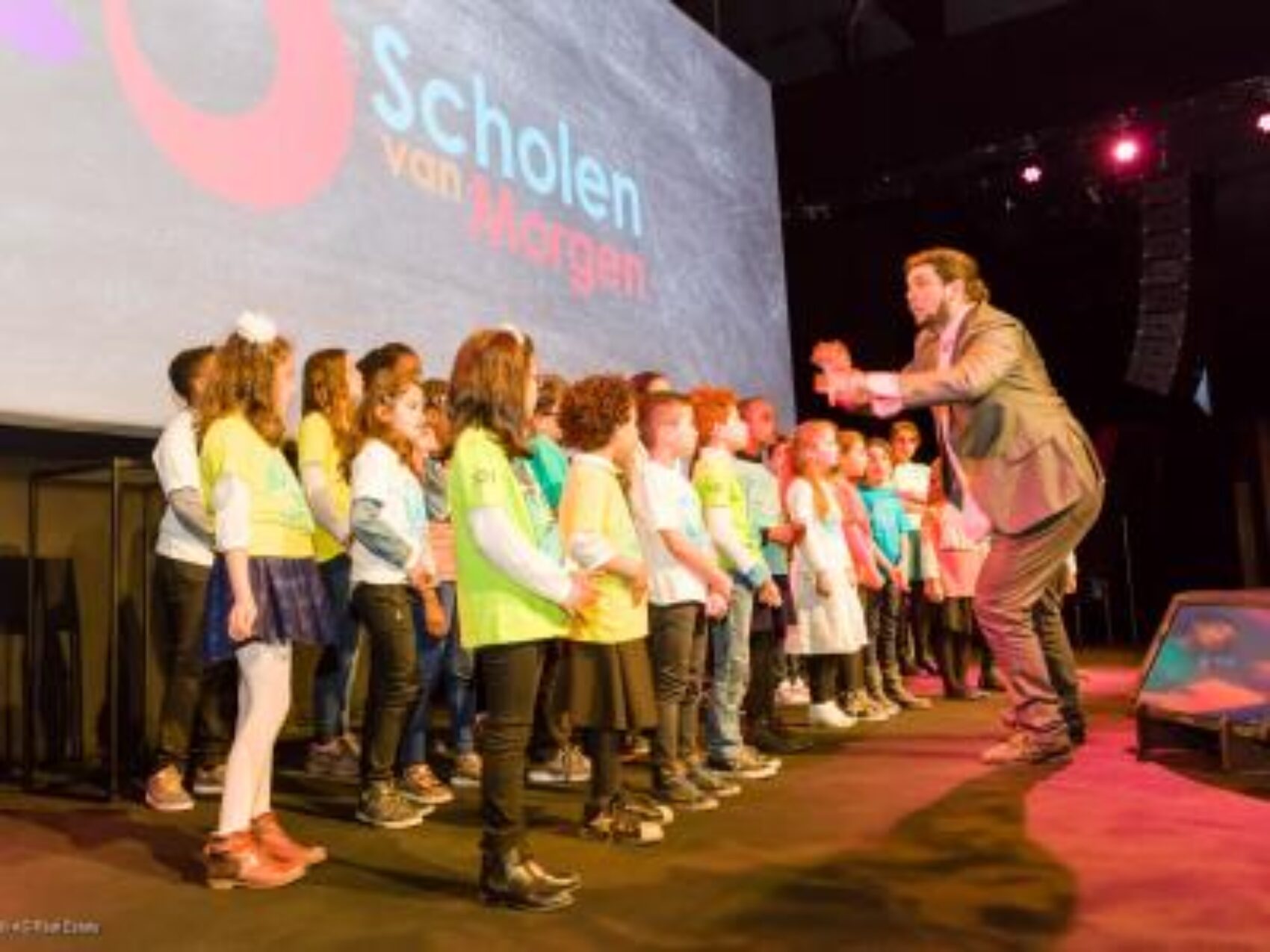
On 22 March 2017, DBFM Scholen van Morgen invited all stakeholders in the programme to an event. To look back together on the 125 projects completed so far under this public-private partnership in school construction. And to share recognisable experiences or pick up on enriching insights.
The motto? ‘Tomorrow starts today’. After all, a significant catch-up effort has already been made to modernise the school infrastructure of ‘yesterday’. This is evident from a number of impressive figures and statistics:
With a total of 182 schools and a total investment of 1.5 billion euros, Schools of Tomorrow is considered the largest social construction project in Europe. In the meantime, 125 new schools have been completed in just over three years. Virtually all of them within the agreed timeframe and budget. “I don’t know of any other construction programmes that can boast these figures,” says Daniël Geerts, general manager of DBFM Scholen van Morgen nv.
Before the programme could achieve such results, its preparation took as long as four years. That is a long time. But it has since been proven that this public-private partnership works. “A partnership within a structured environment was perhaps the very key to our success,” summarises Daniël Geerts.
One of the strengths of the delegated client, AG Real Estate, is that we can already roll out the ‘lessons learnt’ within the programme itself. We operate according to the principle of a self-learning organisation.
Philippe Monserez, Programme Director for Schools of Tomorrow at AG Real Estate
The role of a school in the Schools of Tomorrow programme is somewhat limited. The school communicates its requirements and wishes and will also be the end-user of the infrastructure, but it is the delegated client AG Real Estate that takes on full project management. And this applies to all phases of the DBFM process: design, financing, construction and 30 years of maintenance. This is also one of the key advantages of this way of working: the school management is ‘relieved of the burden’ and can focus on its core educational tasks.
In fact, we had a very personal relationship with the construction team. The site hut was on our premises, so we saw each other regularly, even outside of site meetings.
Annemie De Bie, Headteacher at De Zandloper Zomergem
Furthermore, there are numerous standards (output specifications) that a school building must meet. Not least in terms of light, air and sound. These standards require a great deal of specialist knowledge, but are also the main reasons why the new Schools of Tomorrow feel so comfortable for pupils and teachers.
Another hallmark of the Schools of Tomorrow programme is owner maintenance. This is monitored and carried out over a 30-year period by the delegated client and the maintenance company. During this period, the school submits maintenance reports via an online tool. Behind this lies a system with contractually agreed response times, ensuring that problems are resolved undeniably quickly.
The big advantage is that we actually have very few headaches. It’s all, let’s say, done by specialists.
Luc Louage, management of VTI Roeselare
Ministers of Education Frank Vandenbroucke (2004–2009), Pascal Smet (2009–2014) and Hilde Crevits (2014–present) have successively thrown their weight behind the Schools of Tomorrow programme. All were convinced of the need for such a catch-up initiative. , each phase, they have made their own contribution. And now they are all proud of the results achieved so far.
I must admit I’m a bit taken aback that they’ve managed to meet all those deadlines and realise such a large number of new school buildings at the same time.
Jean Eliaerts, General Administrator of AGIOn
BNP Paribas Fortis and AG Real Estate, a subsidiary of AG Insurance, are leading the programme on the private side. Reinvesting money from the real economy back into the real economy, and in a project of such great social value, makes the private partners enthusiastic and proud. In the press release, Hans De Cuyper and Filip Dierckx describe the programme as a win-win operation.
For the operational partners too, and particularly the architects and contractors, the working method within Schools of Tomorrow was different from elsewhere. During the design phase, a great deal of attention is paid to documentation and standards. This places an administrative burden on the core teams from an early stage. However, thanks to this approach, those standards are now second nature to the architects, and their expertise in school construction has greatly increased, the architects testify.
We must encourage the rules that work. But we must put a stop to excessive regulation. I think we need to preserve the fun factor, including in the process of creating a school.
Leo Van Broeck, Flemish Chief Architect
Within the large-scale programme, every school is unique. And that’s just as well. “Every school context is so different, both in terms of education and environment, that it is really very important to always tailor a school building to its specific needs,” agrees Mieke Rens of HASA architects.
All parties involved appear to agree that the expertise gained in the field of school construction must not be lost. Furthermore, there is a strong desire to take on new projects, both among architectural firms and contractors – provided that lessons learnt are incorporated into the composition of the portfolio and the procedures within the programme.
Schools of Tomorrow is a success story that tangibly embodies the drive to catch up in school construction.
Raf Suys, Chief of Staff to Hilde Crevits